StartingAnthuriumplants from seed is the form of gardening initiative that put up immense satisfaction – if you have the patience .
It is undoubtedly easier to grease one’s palms one of these plant when it ’s fully grown and already blossom , from a reputable nursery or on-line origin .
But those who want to save up the purchase Leontyne Price while experiencing the marvel of nature at oeuvre may need to try distribute anthurium from source .

We link to vendors to help you find relevant products . If you grease one’s palms from one of our links , we may earn a delegation .
Granted , it ’s problematical to find feasible seeded player on the undecided market . And to harvest them from your own plants , you ’ll in all probability have to give Mother Nature an assist with pollination .
Even if you live in USDA Hardiness Zones 10 to 13 , where these tropical works grow as perennials outdoors , there have to be several produce in propinquity to assure they ’ll grouchy - pollinate , and even that may not work on .
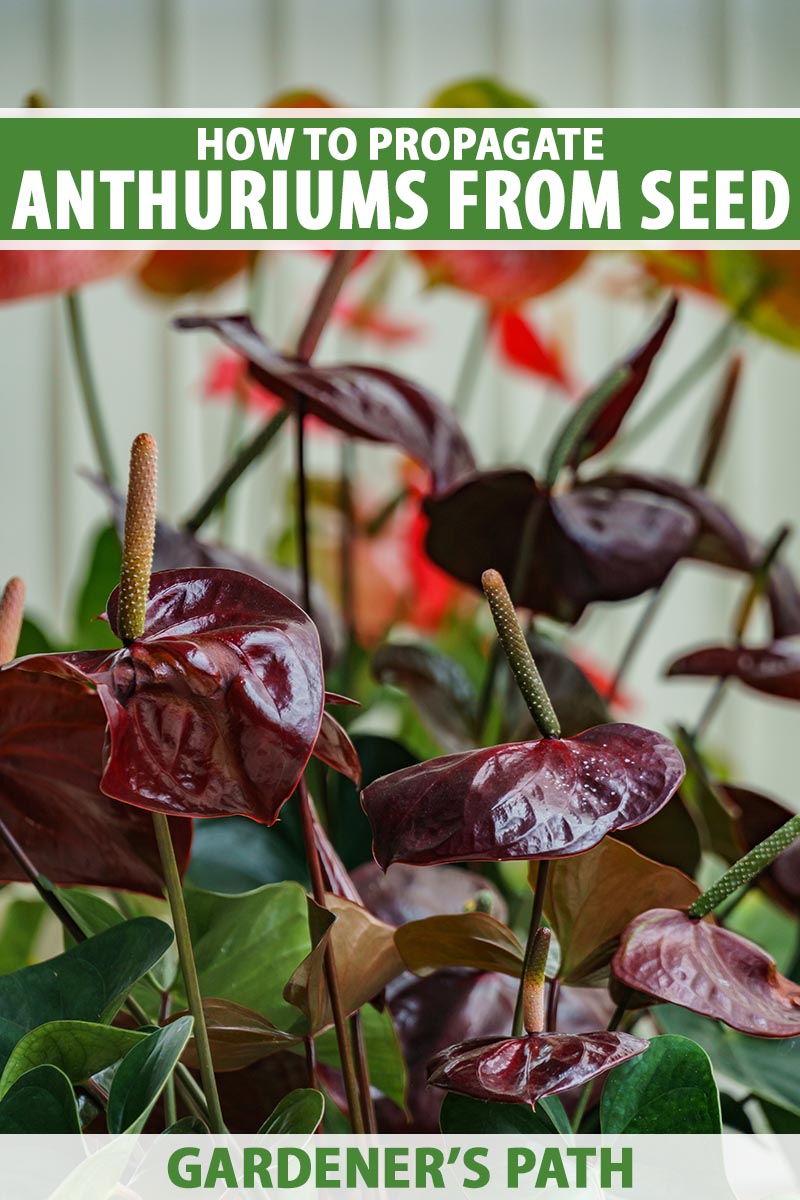
Without sounding too orphic , let me say that the way these bisexual industrial plant produce receptive stigma and pollen - produce pistils on the same spadix but not at the same time – and this complicates pollenation .
It ’s improbable that just a couple , or even a few , plants would ever spontaneously constitute their own viable seeds .
I ’ll explicate more about that aspect of anthurium reproduction as we go along .

But I wanted you to bonk up front that the main caper in starting the seed is procuring them from the plant after successful manual pollination – you in all probability wo n’t have fortune with germination if you endeavor to say them online .
Here ’s what I ’ll incubate :
What You’ll Learn
How Anthurium Plants Produce Seeds
Commercially - available anthurium varieties are ordinarily broadcast from tissue paper culture , a process beyond the scope of all but the most advanced amateur gardener .
Instead , you could begin anthurium plants from cuttings , andour guide has instructions for that . This is the prosperous and speediest way to disseminate at household .
In most cases , rooting anthurium from cut is suitable so you ’ll have newfangled starting signal with the same traits as the parent industrial plant – especially if you ’re growing a uncommon character or one valued for its dramatic foliage more than its coloured spathes .

you may learn miscellanea to grow at home in our guide .
If you ’re an aspiring crossbreed - breeder or you ’re growing the flamingo flower types , it might be appealing to get over - pollinate flowers from a few unlike plants within the same species .
You may get an interesting variation in the resulting plants propagate from seed .

The best place to get seed is from the fruit the pollinated industrial plant produce , which look like tightly packedpomegranatearils . Each yields one or two seeds .
These seeds must be moist to germinate , and they ’re only feasible for a few days after the plant produce them .
While it may be tempting to buy seeds from an online vendor , do n’t do it unless you know for sure that they ’ll be keep moist and ship apace , reach out you a few day after they ’re harvest !

Seeds sold in mail boat wo n’t usually be novel or moist enough .
To understand how an tailflower create viable seeds , let ’s take a look at how they procreate .
First , note that there are types of tail-flower with dramatic leave of absence , like the velvet plant . Others , like the flamingo flower , produce colourful , qualify leafage bracts called spathe .

While many people refer to the colorful spathes as anthurium flowers , they ’re not true bloom with petal . The reliable flowers are inconspicuous and very tiny , cover a short , protuberant spadix that emerges from the snapper of the spathe .
These floweret are “ unadulterated , ” mean each contains both the male and female structures needed to reproduce .
But – and this may seem a little peculiar – the two parts are ready at different times .
Anthuriums have evolved so the distaff stigma are receptive to being pollinate first , and only later do the male pistils produce pollen .
In the state of nature , this inability to self - pollinate strengthen the gene pool for these epiphytes , since they had to cross - pollinate with the audacious nearby flora of the same specie .
But for those who like to reap their own anthurium seed , this inability to ego - pollinate make a vault .
For successful pollination , you ’ll take to intervene , develop pollen from floret in the male form to reassign to receptive mark on other plant ’ blooms .
You ’ll need two or more flora that blossom within a workweek or two of each other , but not at the same time . This increases the odds that receptive distaff stigmas from one plant ’s spadix will emerge at the same fourth dimension when pistils from another plant are produce pollen .
have more than one plant from the same species could also allow you to harvest pollen from one to bring through and use when another plant becomes sensory later on .
I ’d urge tap friends and local houseplant mathematical group on societal medium to see if you ca n’t swap pollen for your anthuriums . This will greatly increase the odds that one bent of floret will be producing pollen as another is becoming receptive .
Just remember the plants will demand to be the same specie to cross - pollinate with each other .
I ’ll divvy up the steps you ’ll require to take in the next surgical incision of this templet .
If pollination is successful , either in the wilderness or after your endeavors , the flush that have been fertilized will form little berry that contain seeds you could sow in .
Hand-Pollination
We ’ll have to discuss intimate anthurium replication a spot more if you want to help the plants form yield you’re able to glean for their germ , so here goes .
normally , the female stigmas on anthurium florets will participate their open phase begin with the ones at the bottom of the spadix .
The lower ace will grow the anastigmatic fluid that indicates their readiness to be cross-pollinate on the floret at the bottom , and then the florets above will start becoming receptive , ending with those in the top of the spadix .
To manually pollinate the flowers , check for the spathe to unfurl , revealing the spadix below . This happens a few day out front of the stigmas being receptive to pollen .
You ’ll be capable to see that a floweret is ready when it releases a drop-off of anastigmatic fluid , usually in the morn .
Three to five anther will come forth and fence in that receptive stigma , which will wait shiny and glisten with wet .
Thisarticle from the University of Florida extension serviceincludes two helpful close - up photos of sensory stigmas , to give you an idea of what you ’re look for .
The open female form will last a day or more for each floweret , with subsequent florets releasing anastigmatic fluid with each passing day .
That ’s when you ’ll want to manually pollenate . But you ’ll call back that this plant has not yet released pollen , so where will it total from ?
You ’ll have to collect it from another plant that ’s already surpassed the receptive leg and moved on to the male stage of producing pollen via the floweret ’ pistil .
To notice a plant life ’s readiness to release pollen , flat after the receptive stage , look for anastigmatic surface that have move from glistening and burnished to becoming dry and brown . That ’s a certain star sign pollen is quick to be release .
Even if some or all of the florets were fertilise , they will still free pollen later .
search for pollen to appear along the spadix , starting near the radix . The same University of Florida bulletin has a photo of the pollen that could be helpful .
Since the flowers mature at different rates , the pollen may be make over the course of a couple of weeks .
If you ’re lucky enough to have one set of florets that is in the receptive stage and another ( in all likelihood on another plant ) that has moved on to producing pollen , you could just collect the pollen on your fingertip or the tip of a dry , lightheaded paintbrush to transfer to the surface of the receptive brand .
Gently splatter or massage the pollen into the brand , and iterate the cognitive process each daylight for several Clarence Day until the stain is no longer glistening or you break away out of pollen .
If there ’s a stave between the meter pollen was useable and another flora ’s floret were quick to be fertilized , you may be able to store the pollen .
you may collect it on the baksheesh of a brush and then dust it into a minuscule , airtight container to hatch and property in the fridge for up to a workweek . Do n’t let it add up into contact with any wet during that clock time though , or it will fall back its potency .
Some also swear by freeze out pollen , but I ’d only do that if you have no other option . It might not be practicable by the time you get to employ it .
To freeze down tail-flower pollen for future use , you ’d take a humble field glass test tube , sweep the available pollen in , and gently cap it before storing it in the freezer .
You ’ll desire to practice it as quick as possible , as it ’s most probable to continue potent for just a week or two , though some arrogate success with pollen that ’s been freeze for as long as a year .
Before applying this lay aside pollen to stigmas that become centripetal at a later date , be sure to get the metro out of the freezer a couple of hour before you need it , lease it amount to room temperature slow .
After the florets cycle through being open to fertilisation and farm pollen , they ’ll either shrivel and drop , or start to plump up and form fruit .
This fruit get as a greenish bite of protective flesh , and gets a bit larger and redder before the seeds are practicable . The berry are commonly red , rosiness , or dark yellow and about the size of pomegranate aril when they ’re ripe .
These Chuck Berry are matured when they quit getting bigger and then commence to light from the spadix . Each contains one or two seeds .
Act now to drink down the Chuck Berry , gently allay out the still - moist semen , and sow them .
command for that are coming right up .
Sowing Seeds
Once you have viable seeds in hired hand , the planting process is more typical and much like what you ’d follow to propagate other ornamentals from seminal fluid .
Sow these fresh tail-flower seeds immediately , first moistening a duo of inch of vermiculite in a prostrate or shallow pot with drainage gob .
you’re able to also utilize a sprouting monotonic with a domed lid , like this 12 - cell optionavailable from straight Leaf Market .
12 - Cell Seed Starting Set
Mix the seeds with a handful of fine - textured seed starting mixture , and then push them into the vermiculite surface . Strive to put them about an inch apart .
Spray the soil open with piss as needed so it last out moist , and come in the flat in a spot where the temperature is around 70 ° F .
To speed germination , cover the container with clear plastic wrap to hold in wet , or apply a clear dome lid .
Look for the seeds to sprout between three day and a week afterward .
Once they ’ve germinated , take the cover .
Caring for Seedlings
From there , place them in bright , indirect light . go forward to provide uniform moisture and the warm temperature these tropical plants will appreciate .
They ’ll develop slowly and wo n’t be ready to move into their own individual potentiometer until they ’ve forge radical that are at least a couple of inches long and a duet of set of on-key leaves .
One caution : tail-flower grown from seed wo n’t evolve those dramatic leaves or endearing spathes in various colors until the plants are three or even four yr old .
So if you ’re going to show a dynasty of anthurium plant started from source , you ’ll want to sow Modern seeds at every chance instead of waiting to see what develop from your seed - grown plant first .
From Seed to Showy Houseplant
If you have the patience and the field , you may be capable to start new tropical anthurium plants with the aid of only some seed starting mixing , a brush for pollinating flowers , and of course , at least a pair of blooming industrial plant to supply that precious pollen and receptive brand .
And formore selective information about growing anthuriums , have a read of these template next :
© take the Experts , LLC . ALL right hand RESERVED.See our TOSfor more contingent . ware picture via dead on target Leaf Market . Uncredited photos : Shutterstock .
About
Rose Kennedy
